

More people are living in this world than ever before in history. But is this burst of population uniform across the world? According to world bank database the population of world has increased from 5.3 billion in 1990 to approximately 8 billion in 2022 but this growth in population has been uneven as most of this population growth has been from the middle- and low-income countries. High income countries on the other hand have seen a modest increase in population growth from 1 billion in 1990 to 1.25 billion in 2022. Another question we must ask is the population growth only because of the increase in the birth rate? If not, what is the other factor impacting this population growth? World Bank data from 1990 to 2022 tell us that fertility rate (per woman) has declined from 3.3 in 1990 to 2.3 in 2022 and in the high-income countries this has been low decreasing from 1.9 in 1990 to 1.5 in 2022 which is below the 2.1 considered optimal rate to sustain the population. This trend clearly shows that population growth in the high-income countries is not from child births but from other factors. Now to explore these other factors we need to analyze the population growth of different age groups in the population pyramid.
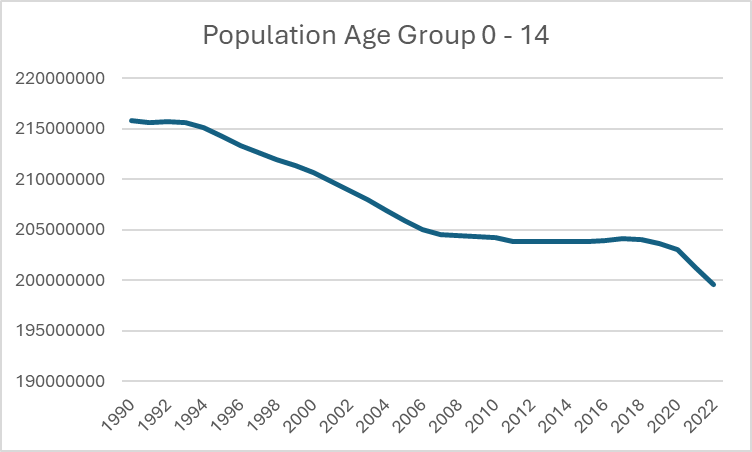
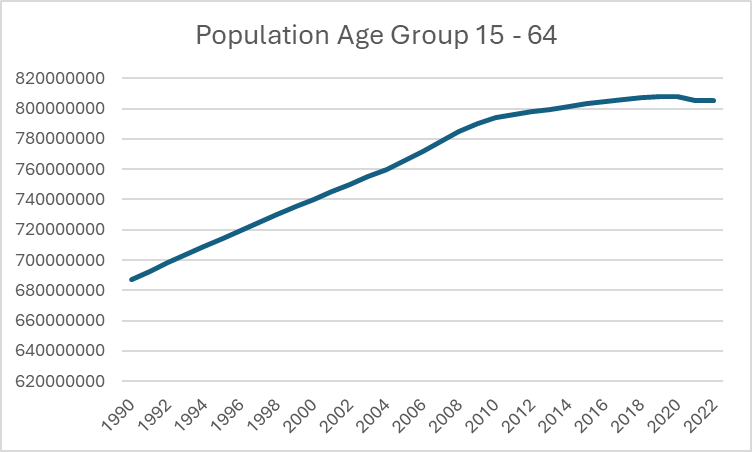
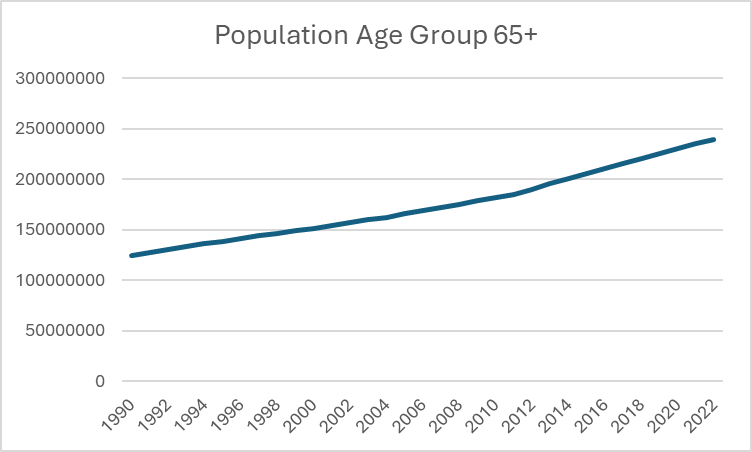
The graphs show us that the population between age group 0-14 decreased by 7.5% (1990 -2022) while population between age group 15-64 increased by 17.25% (1990-2022) a major increase in population is because of a population explosion in the age group of 65+ which increased by 91.8%. This trend clearly shows that increasing population in the 65+ age group is the major factor in this population growth.
The economy of a country is affected by many factors like Human Resources, Physical capital, Natural Resources, Technological Development, Entrepreneurship and Social and Political structure. Human Resources/ working population is the backbone of a country’s economy and is a major factor affecting its Gross Domestic Product. The trends of high-income countries are showing a stagnation in working population growth (Decline in 2020) in recent times. But can we correlate this stagnation of working population in high-income countries to slow economic growth of these countries? It’s very difficult to isolate one factor pinpointing towards the economic decline of the country. This is specifically true in the current era of globalization connecting economies like never before with events in one country affecting the others. Example: The 2008 Financial crisis and 2020: Corona Pandemic affecting not just their host countries but everyone. These factors have a sever affect on the economy of a country, thus by comparing the economic and population growth of the country with respect to the world will help us isolate these factors. As we have isolated these factors the last question we must ask before doing analysis is which country to choose for this correlation? Italy is the perfect country for this analysis as they had ample of human resource in the past but due to decrease in their birth rate lead to a stagnant working population.
| Regression Statistics | |
| Multiple R | 0.427096 |
| R Square | 0.182411 |
| Adjusted R Square | 0.124012 |
| Standard Error | 1.540621 |
| Observations | 31 |
| ANOVA | |||||
| df | SS | MS | F | Significance F | |
| Regression | 2 | 14.82741 | 7.413703 | 3.123513 | 0.05963378 |
| Residual | 28 | 66.4584 | 2.373514 | ||
| Total | 30 | 81.28581 |
| Coefficients | Standard Error | t Stat | P-value | Lower 95% | Upper 95% | Lower 90.0% | Upper 90.0% | |
| Intercept | -4.00553 | 0.813911 | -4.92134 | 3.44E-05 | -5.672751972 | -2.33831 | -5.3901 | -2.62096205 |
| change in labour force vs world | -15.4843 | 28.34503 | -0.54628 | 0.589202 | -73.54642921 | 42.5779 | -63.7029 | 32.73434604 |
| change in total population vs world | -140.564 | 78.53998 | -1.78972 | 0.084321 | -301.4461461 | 20.31755 | -274.171 | -6.95751757 |
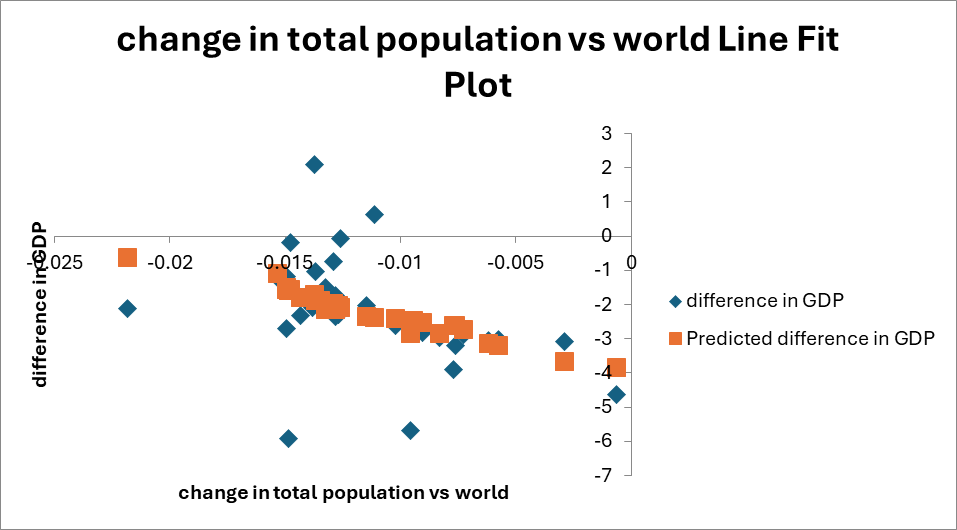
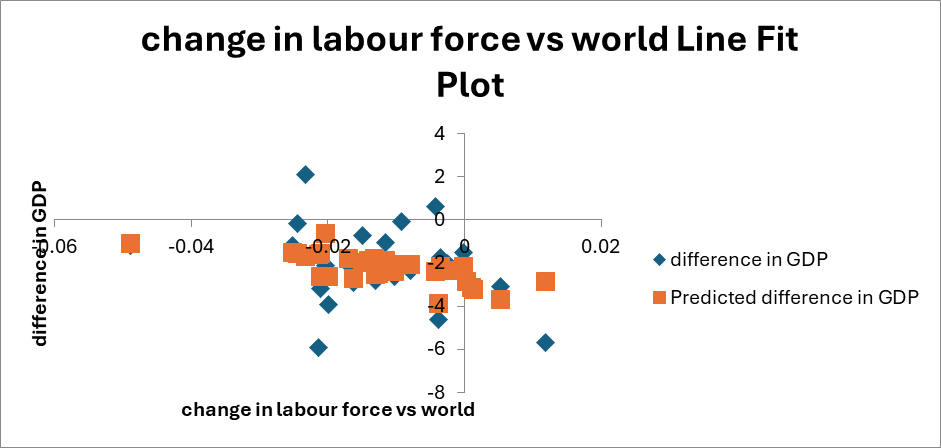
Regression statistics shows us that 18.2% change in dependent variable can be attributed to the independent variable which in our case are change in total population of Italy vs world and change in labor population of Italy vs world. Anova also validated this result as it shows correlation between the variable with more than 94% confidence level. This result shows that stagnation in population growth can lead to a decline in economic growth. Now as we have proved that population decline leads to slow economic grow what the solution to this problem? The first solution that comes to mind is Immigration, but it not only changes the demographic identity of the country it also doesn’t fix the root cause of this problem i.e. reduced birth rate.
Next generation Funds can be the revolutionary solution to this reduced birth rate as they target the root cause of the problem by providing financial support to the families. This in long term help increase the birth rate which started to decline in this modern era in which children are not just seen as another asset helping hand in the household as seen in the past but as a liability which needs to be taken care for. These fund though an additional burden on the economy in the short run can prove to be extremely valuable for a country long term stability. These funds should encourage people to have more and more children hence helping in reversing the population pyramid.
Leave a Reply